

At my CEF Insider service, we started 2026 bullish. We still are.
Why? AI, sure. But the real answer is simpler: The data simply tells us that the US economy is stronger than most people think.
Sometimes, admittedly, the data is weaker than we’d like, but no real disasters have appeared. So we’ve kept on our bullish course, continuously adding high-yielding closed-end funds (CEFs) to our portfolio, while taking profits on our holdings from time to time.
With that in mind, and with the halfway point of the year only just behind us, I wanted to bring up one fund that’s performed very well for us indeed, and continues to look strong as we roll into the back half of 2026 (and beyond).
I’m talking about the John Hancock Financial Opportunities Fund (BTO), which was our first addition to the CEF Insider portfolio this year, in the January issue of the service, which came out on the 23rd of that month.
BTO has a lot going for it, especially for income investors like us: Its 6.5% yield is more than six times what the typical S&P 500 index fund pays. And that payout is growing, up an eye-popping 76% in the last decade.
A 6.5% dividend that grows! I know I don’t have to tell you how rare that is. And we haven’t sacrificed performance here, either, as the fund (in orange below) has been outperforming the go-to S&P 500 index fund, the State Street SPDR S&P 500 ETF Trust (SPY), in purple, since our buy.
BTO Outruns 2 Key Benchmarks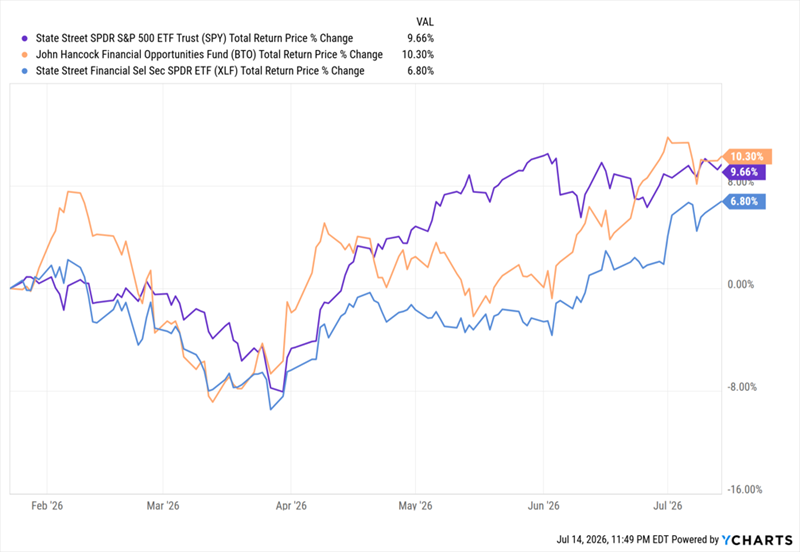
I know that’s a small margin, but BTO holds another key edge: Much of that return came to us as dividend income. But you’ll see that I’ve also included the finance-sector benchmark State Street Financial Select Sector SPDR ETF (XLF), in blue above. That’s a fairer comparison for BTO than SPY is. And as you can see, our CEF has blown its ETF “cousin” out of the water.
You’d expect investors to reward that kind of run, and yet BTO’s discount to net asset value (NAV, or the value of its underlying portfolio) stands at 4.1% as I write this. That’s a bigger discount than it was at the start of the year, despite BTO’s strong return.
BTO’s NAV-Driven Discount 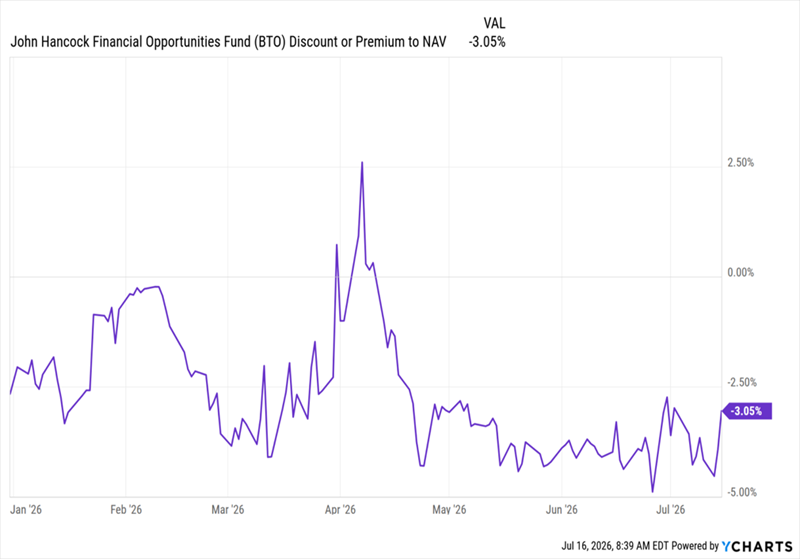
There are two ways a CEF’s discount can shrink: The “bad” way is when its assets fall in value faster than the market can price in those losses. This is what happened to BTO (and many other CEFs) when the Iran conflict broke out.
The “good” way is when its assets rise quicker than the market can price in those gains. This is also what’s happened to BTO, since its NAV returns (in orange below) have consistently been ahead of its market price-based returns since we bought in late January.
BTO’s Fundamentals Have Led Its Market Price-Based Gains Higher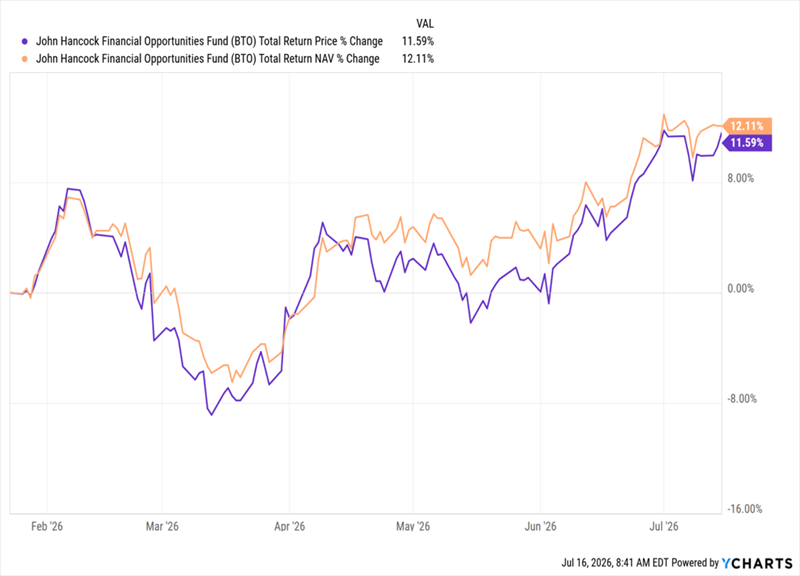
The NAV gains are important because they show us that management is earning a real return by holding assets that are rising in value.
They’re also important because they directly fund a CEF’s dividend. And here we see that BTO’s dividend is well-covered just by the 12.1% total return on NAV the fund has generated in just the last few months. This also opens the door to further payout growth.
Now let’s talk about the fund’s portfolio, which largely consists of regional banks, with Old National Bancorp (ONB), Pinnacle Financial Partners (PNFP), and Popular Inc. (BPOP) as top positions.
Regional banks are doing well because the US economy is doing well, and the decline in inflation we’ve seen since 2022 (even though the consumer price index remains historically high) is helping regional banks earn more profits from their banking activities.
That’s benefiting BTO, but the fund is also profiting from another trend that’s boosting national banks, as well. With more stock trading and lower credit losses from bad loans, big banks are posting “blockbuster profits as equities trading booms,” as the Financial Times puts it.
The regional banks in BTO’s portfolio also lend to companies, and those loans are safer due to a decline in credit losses, which boosts BTO’s NAV. Additionally, these banks’ wealth-management arms are also doing well thanks to the strong stock market.
All of this is why BTO has performed so well in the last few months. But why is this CEF also beating the national banks, who more directly benefit from more equity trading and lower credit losses? This chart explains it:
BTO’s Short-Term Underperformance Is an Oddity …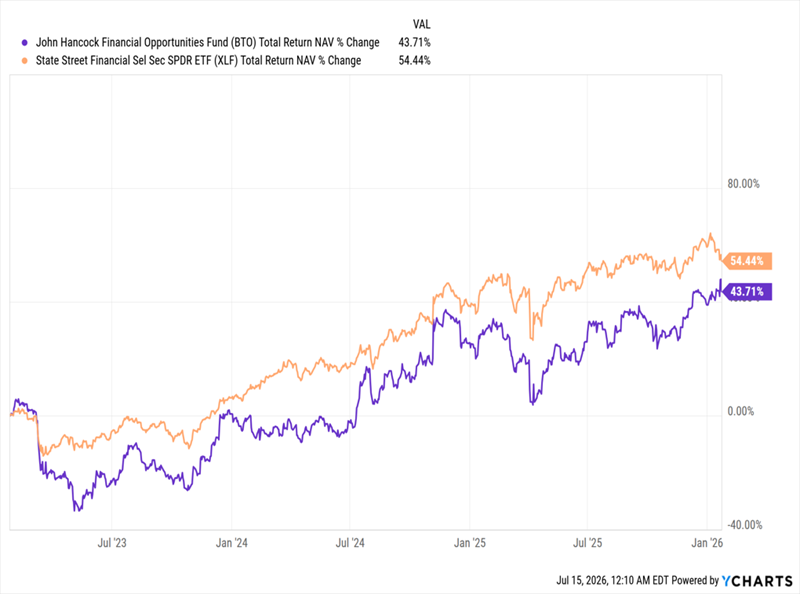
For the three years prior to our buy, BTO (in purple above) saw its NAV underperform XLF (in orange) as market demand for big-bank stocks exceeded demand for local-bank stocks. But this is not normal.
… as the Fund Crushes Big Banks in the Long Run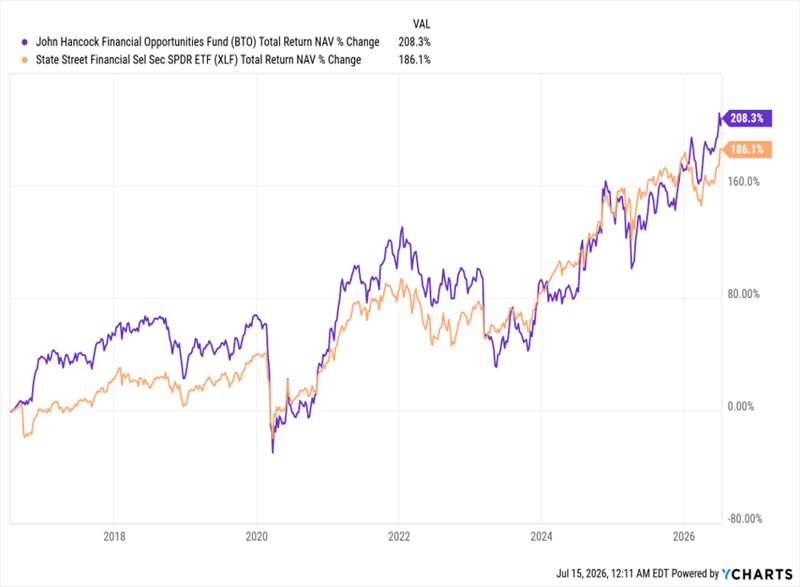
Over the long term, BTO’s NAV (again in purple above) has outperformed XLF (in orange), so when XLF beats BTO in the short term, that’s a sign BTO is a buy, provided conditions favor banks as a whole. That’s why we bought BTO in January.
So where does all this leave us? While BTO’s discount still intrigues us, the fund is just a hair above my $39.00 buy-up-to price at the moment. While we still love BTO, this just means we’re looking to other funds in our portfolio when we have new money to invest.
We are keeping a close eye on this one, though–and happily collecting its payout. We’ll add more (and build on our BTO income stream in the process) on any dips.
These 9.7% Monthly Payers Are Top Buys Now (While We Wait for a “BTO Dip”)
I’ve got the perfect “companion pieces” for BTO for you: 5 other CEFs that pay dividends monthly–and yield 9.7%, too.
Here’s why I say they’re the perfect match for our finance-focused CEF: While you wait to pick up BTO on the next dip, you can buy these 5 reliable monthly payers right now–and kickstart the 9.7% monthly dividend stream they provide.
Then you can add in BTO, with its slightly lower (but still very high) 6.5% payout that’s growing, when the opportunity presents itself.
The result? Dividend (and price) growth, with a strong base of 9.7% dividends that come your way monthly.
These 5 monthly payers are all bargains now, too, giving us the perfect entry point. Click here and I’ll introduce you to them–and give you a free Special Report called, simply “5 ‘Must-Own’ Monthly Dividend Funds Yielding 9.7%.” In its pages you’ll get my research on each of these 5 funds, including their names and tickers.