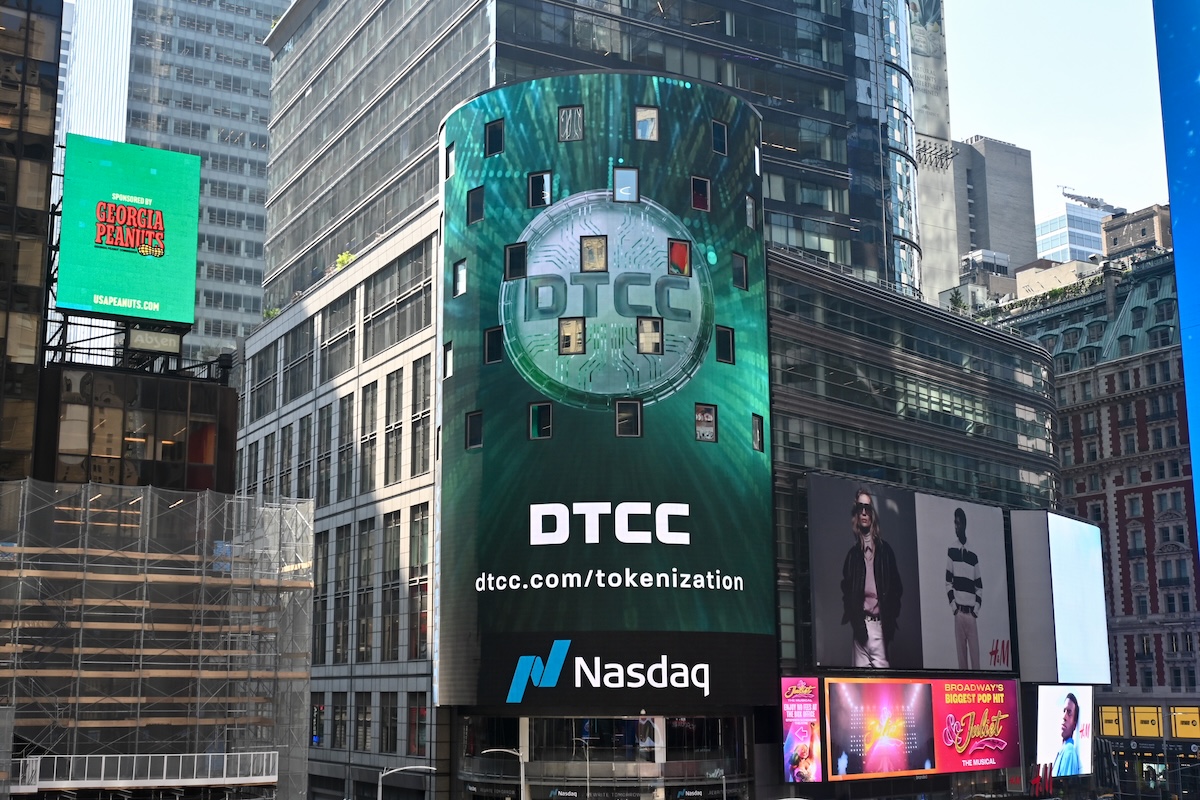
On Wednesday, July 15th, the Depository Trust & Clearing Corporation (DTCC) partnered with Nasdaq and a host of other industry leaders for a landmark test run to process U.S. trades in a tokenized format. This effort aimed to help modernize the infrastructure beneath today’s markets by unlocking greater efficiency, enhancing liquidity, and enabling a global, always-on financial system.
This event demonstrated that DTCC’s tokenization service can serve as a bridge between mainstream markets and digital markets. Throughout the day, DTCC successfully converted production trades on The Nasdaq Stock Market whereby assets held at The Depository Trust Company (DTC) were converted into tokens held in a digital control account and corresponding member firm wallet. The exercise demonstrated tokenization production in a breadth of use cases, asset classes, and number of participants—paving the way for the launch of DTCC’s Tokenization Service later this year.
Nasdaq’s Role
Besides Nasdaq, more than 30 firms participated in the event, including Nasdaq member firms, blockchain networks, applications, digital wallets, exchanges, and other market participants.
“Nasdaq played an integral role in this event by demonstrating how tokenization can work within existing market rules while supporting liquidity, transparency, and investor protection,” said Chuck Mack, Senior Vice President of North American Markets at Nasdaq.
During the July 15 event, The Nasdaq Stock Market served as the marketplace where trades were executed for later conversion into tokens at the DTCC. Additionally, the Invesco QQQ exchange-traded fund—which tracks the Nasdaq-100 stock market index—was one of the key securities used during the tokenization exercise.
“Nasdaq was a key partner across several use cases showcased during the event,” said Brian Steele, Managing Director and President of Clearing & Securities Services at DTCC. “For example, in one use case, a DTC Participant executed a trade to purchase a security that is listed on Nasdaq, and those shares were then tokenized and made available on blockchain rails.”
From Nasdaq’s perspective, this initial run of tokenized asset trades is a significant milestone because it shows that tokenization can occur within existing regulatory frameworks.
“Preparing for the day required close coordination across technology, operations, and regulatory teams to ensure a positive experience,” Mack said. That effort showed that meaningful innovation in capital markets is possible, he added, especially when key industry participants are “pushing in the same direction.”
“U.S. equity markets are the deepest and most liquid in the world and this event shows that blockchain technology can be incorporated into the financial markets,” Mack said. “Real-world transactions help build confidence that digital infrastructure can scale in a way that supports investor protection, price discovery, deep liquidity, and transparency.”
“As a global market operator and financial technology provider, Nasdaq is excited about the opportunity to connect mainstream and digital markets”, Mack said. He added that “Nasdaq believes that collaboration across trading and post-trade ecosystems is essential for tokenization to scale.”
When Nasdaq thinks about scale and supporting market evolution, Mack said, “the focus is to provide solutions that serve investors, issuers, and the global financial markets.”
What Comes Next
The DTCC Tokenization Service is expected to officially launch in October 2026.
“Our goal was to demonstrate that we can apply the same institutional rigor to digital assets as we do for traditional assets while continuing to safeguard the integrity and resiliency of the global financial market. We also wanted to demonstrate how seamless interaction can work across networks, platforms, and existing market infrastructure,” Steele said.
When the DTCC Tokenization Service launches in October, it will introduce a digital representation (also known as a digital twin) of traditional real-world assets within a regulated, institutional framework.
“Tokenization has the potential to deliver meaningful benefits while preserving institutional safeguards and protections that market participants expect,” Steele explained.
Bridging Mainstream Markets and Digital Markets
Steele emphasized that DTCC and its partners are bridging mainstream and digital markets in a controlled, responsible manner without introducing new risks or fragmentation.
Nothing about market safety or fundamental structure is changing with the Tokenization Service: DTC will remain the official recordkeeper and securities intermediary for DTC-held assets, even when assets are tokenized.
“It’s important to note that this is an evolution of the current system, not a replacement. The safeguards we are known for remain firmly in place,” Steele said.
He added that DTCC will remain neutral and will provide interoperability across blockchain networks and wallets. Steele said the firm does not believe the industry will coalesce around one specific network or wallet, “so choice and interoperability are critical.”
For its part, DTCC is uniquely positioned to help drive industry-wide adoption at scale, he said: “As the backbone of the financial services industry, DTCC can help bring tokenization into the mainstream in a safe and coordinated way.”
For Nasdaq, the event underscored the belief that the next phase of market evolution will be driven by greater connectivity between mainstream markets and blockchain technology, built on trusted, regulated infrastructure that has contributed to the size and success of U.S. markets.
Learn more about the partnership.